Sunday, May 6, 2018

Pros and cons of the new digital pills that connect to your smartphone


The disadvantage here is the patient’s privacy as this will be given away by the technology. Is it necessary to bring on board bio medics into the patient doctor confidential agreement? A kind of agreement is signed by the patient but it does not stop the patient being watched by a third party.
The challenge is that some patient’s will readily go against this due to privacy challenge, secondly patients might begin to miss time of visits to their physician since they believe they are already being monitored.
Another big one is the question of the data banks for all these information. The new age which makes it possible for big companies to get hacked, safety of the patient’s privacy is termed as relatively low.
 http://blogs.rediff.com/markterry/2018/05/01/pros-and-cons-of-the-new-digital-pills-that-connect-to-your-smartphone/

 Image result for Pros and cons of the new digital pills that connect to your smartphone inurl:gov

Technology and the Future of Mental Health Treatment

Technology has opened a new frontier in mental health support and data collection. Mobile devices like cell phones, smartphones, and tablets are giving the public, doctors, and researchers new ways to access help, monitor progress, and increase understanding of mental wellbeing. Mobile mental health support can be very simple but effective. For example, anyone with the ability to send a text message can contact a crisis center. New technology can also be packaged into an extremely sophisticated app for smartphones or tablets. Such apps might use the device’s built-in sensors to collect information on a user’s typical behavior patterns. If the app detects a change in behavior, it may provide a signal that help is needed before a crisis occurs. Some apps are stand-alone programs that promise to improve memory or thinking skills. Others help the user connect to a peer counselor or to a health care professional.

https://www.nimh.nih.gov/health/topics/technology-and-the-future-of-mental-health-treatment/index.shtml

Thursday, April 26, 2018

Prescription Drug Pricing Is Totally Broken


 Image result for Prescription Drug Pricing Is Totally Broken inurl:gov


Some new applications like GoodRx can help the patients to compare prices of drugs from various pharmacies and programs in different locations before committing to buying them, and this way they can get up to 75% off on the market price of the medication they need.

Solutions to the pricing problem that is affecting generic drugs-drugs that are supposed to be a safe and cheap alternative for the masses-are direly needed. More than 50% of Americans are struggling with a chronic illness, and the majority of them cannot afford the exorbitant prices of drugs. It is not only essential, it is necessary that healthcare reforms target this area of drug pricing so that drugs can be accessible to the average American who needs them. The high cost of drugs in America is a problem that needs swift and decisive solutions now, rather than later.

https://www.buzzfeed.com/maximmaider/prescription-drug-pricing-is-totally-broken-even-3be9o

Appeals if you have Medicare prescription drug coverage

You have the right to do all of these (even before you buy a certain drug):
  • Talk to your prescriber - your doctor or other health care provider who's legally allowed to write prescriptions. You can ask:
    • Whether the plan has special coverage rules
    • Whether there are generic, over-the-counter, or less expensive brand-name drugs that could work as well as the ones you're taking now.
  • Get a written explanation (called a coverage determination) from your Medicare drug plan. A coverage determination is the first decision made by your Medicare drug plan (not the pharmacy) about your benefits, including these:
    • Whether a certain drug is covered
    • Whether you have met the requirements to get a requested drug
    • How much you pay for a drug
    • Whether to make an exception to a plan rule when you request it
  • Ask for an exception if:
    • You or your prescriber believes you need a drug that isn't on your plan's formulary.
    • You or your prescriber believes that a coverage rule (like prior authorization) should be waived.
    • You think you should pay less for a higher tier (more expensive) drug because you or your prescriber believes you can't take any of the lower tier (less expensive) drugs for the same condition.
     
https://www.medicare.gov/claims-and-appeals/file-an-appeal/prescription-plan/prescription-drug-coverage-appeals.html

Sunday, April 1, 2018

One Stop Information for Generic Drugs


It’ no longer a secret that healthcare can be very expensive in this country. It can lead you into financial burden when you don’t have proper health insurance. One of the reasons medical treatment so expensive is the high medicine price. The manufacturers of those medicines argue that high investment to cover research to all procedures until a medicine is ready to market is the main reasons of the high priced medicines.
http://ehealthservices.eu.org/one-stop-information-for-generic-drugs/


FDA Guidelines for Medication Guide Distribution
 The e-pedigree law requires
a track and trace system for all
prescription drugs sold in California,
tracing ownership of the smallest
saleable unit of each prescription
drug from manufacturer to dispenser.
The pedigree must be initiated by
the manufacturer and electronically
appended at every change in ownership
by wholesalers, pharmacies or other
dispensers. The law was based on a
2004 report of the FDA’s Counterfeit
Drug Task Force which had been
formed to establish a federal level
solution to safeguard the nation’s
prescription drugs. This report
recommended a system that would
electronically identify each product as
it moved through the supply chain. A
unique number was to be placed on
the saleable unit by the manufacturer
that could be electronically read. An
interoperable computer system would
allow the e-pedigree to be appended
at each sale with required elements,
including a statement by the seller that
it is selling the unit to a specific buyer,
and a corresponding statement from
the buyer that it is buying the product
from the specific seller. This creates a
locked chain of custody of the product,
electronically tracing all owners back
to the manufacturer.
http://www.pharmacy.ca.gov/publications/13_mar_script.pdf


Tuesday, March 13, 2018

Some people with HIV are starting to live as long as people without it


The publishers of the new research studied the results of 18 studies about patients living with HIV in Europe and in North America. Factors such as the amount of virus that iswas present (lower is better) and CD4 white blood cell count (higher is better), which are normally used to measure the severity of the infection was considered. These measures improved in people who started treatment in cohort groups that started treatment afterwards.
The real difference appears to come from the medications that have been not very harmful over time, and better devotion to taking them. However, people living with HIV may experience other complications, warns Scott Turner, a neurologist at Georgetown University who studies HIV and is not affiliated with the new research. For instance, he says, “Since aging is a major risk factor for HIV-associated neurocognitive disorder (HAND), we may expect to see a parallel increase in HAND in coming years.” Turner has treated more than a few patients who have lived with HIV long enough to have Alzheimer’s even though they may have presented it earlier than usual as a result of the HIV virus and treatment.

https://article.wn.com/view/2018/03/13/Some_people_with_HIV_are_starting_to_live_as_long_as_people_/


The Stages of HIV Infection

Without treatment, HIV infection advances in stages, getting worse over time. HIV gradually destroys the immune system and eventually causes acquired immunodeficiency syndrome (AIDS).
There is no cure for HIV infection, but HIV medicines (called antiretrovirals or ARVs) can prevent HIV from advancing to AIDS. HIV medicines help people with HIV live longer, healthier lives. HIV medicines also reduce the risk of HIV transmission (the spread of HIV to others).


There are three stages of HIV infection:
  1. Acute HIV Infection
    Acute HIV infection is the earliest stage of HIV infection, and it generally develops within 2 to 4 weeks after a person is infected with HIV. During this time, some people have flu-like symptoms, such as fever, headache, and rash. In the acute stage of infection, HIV multiplies rapidly and spreads throughout the body. The virus attacks and destroys the infection-fighting CD4 cells of the immune system. During the acute HIV infection stage, the level of HIV in the blood is very high, which greatly increases the risk of HIV transmission.

https://aidsinfo.nih.gov/understanding-hiv-aids/fact-sheets/19/46/the-stages-of-hiv-infection

Wednesday, February 28, 2018

GENERIC DRUGS AND THE FDA


Generic drugs are replicates of brand-name drugs that come with the same dosage, intended use, effects and side effects, route of administration, risks, safety, and strength as the original (patented) medication. Generic drugs usually are more affordable than the brand name drugs they have patterned after.

This situation occurs for a number of reasons. The first is that the manufacturer of parent medication has spent considerable resources on the research, development, marketing, and promotion of the drug.  Hence these incident costs are usually included in the final price of the drug. On the other hand, generic medicine is developed after its parent drug runs the course of its patent rights, which often spans close to 20 years. For example: co-aleva. A generic drug comes to the market quicker and cheaper because it bypasses most of the base costs/processes associated with producing the parent drug from scratch.

http://groupspaces.com/genericdrugs/

Abbreviated New Drug Application (ANDA)


An abbreviated new drug application (ANDA) contains data which is submitted to FDA for the review and potential approval of a generic drug product. Once approved, an applicant may manufacture and market the generic drug product to provide a safe, effective, lower cost alternative to the brand-name drug it references.
A generic drug product is one that is comparable to an innovator drug product in dosage form, strength, route of administration, quality, performance characteristics, and intended use. All approved products, both innovator and generic, are listed in FDA's Approved Drug Products with Therapeutic Equivalence Evaluations (Orange Book).
Generic drug applications are termed "abbreviated" because they are generally not required to include preclinical (animal) and clinical (human) data to establish safety and effectiveness. Instead, generic applicants must scientifically demonstrate that their product is performs in the same manner as the innovator drug. One way applicants demonstrate that a generic product performs in the same way as the innovator drug is to measure the time it takes the generic drug to reach the bloodstream in healthy volunteers. This demonstration of “bioequivalence” gives  the rate of absorption, or bioavailability, of the generic drug, which can then be compared to that of the innovator drug. To be approved by FDA, the generic version must deliver the same amount of active ingredients into a patient's bloodstream in the same amount of time as the innovator drug. 
https://www.fda.gov/Drugs/DevelopmentApprovalProcess/HowDrugsareDevelopedandApproved/ApprovalApplications/AbbreviatedNewDrugApplicationANDAGenerics/default.htm

Saturday, February 24, 2018

GENERIC DRUG PRICING AND THE END GAME

Generic drugs have been hailed for the impact they have had on the United States healthcare industry. These group of medicines has ensured that Americans have access to affordable yet qualitative prescription medicine, thereby ensuring improved healthcare delivery.
At its most basic, a generic drug is a copy or replica of a brand-name drug, dispensed with the same dosage, intended use, effects and side effects, route of administration, risks, safety, and strength as the original (patented) drug. Unlike the original medication, a generic drug enters the market at much less a cost compared to that for a brand name due to lower production costs and less stringent regulatory approval routes/paths.

http://www.postpoems.org/authors/artic1904/prose/1060242

The Business Dynamics of Generic and Brand name medication
While the usage statistics for generic drugs means that Americans can access cheaper yet effective medicine, the returns on investment for generic drug production may prove to be its death knell.  Consider that supply chain dynamics for generic drugs give a return on investment of 64 percent, while brand name manufacturers posts as much as /retain over 76 percent of revenue.
While these numbers do not differ to large extents, the impact is telling. This is because of the nature of the two markets involved- generic and brand name.  It is important to note that the brand drug industry is generally controlled by one manufacturer with exclusivity (patent rights for a period of time), while the generic industry follows a multi-competitor model with drug prices decreasing as more competitors enter the marketplace, given the less expensive/arduous path to market entry.
http://www.medicalmingle.com/doctor1970/blog/2018/02/24/generic_drug_supply_chain_and_other_matters

 Image result for Statement from FDA Commissioner Scott Gottlieb, M.D. on new steps to facilitate efficient generic drug review to enhance competition, promote access and lower drug prices


Statement from FDA Commissioner Scott Gottlieb, M.D. on new steps to facilitate efficient generic drug review to enhance competition, promote access and lower drug prices

In the United States of America, the figures are more compelling. The FDA continues to propose and enforce regulatory policies that give great traction to the development and deployment of generic medicine. Some of these policies include the following:
1. Improving the efficiency of the generic drug approval process.
2. Providing advisory services to developers of generic medicine in capacity and knowledge building.
3. Creating policies that favor the development of a new class/category of generic drugs referred to as complex drugs.
As a result of these efforts, the US has achieved impressive figures with the use of generic medicine.

https://www.bloglovin.com/@teddyredwings/generic-drugs-savings

This new MAPP does not alter the important Generic Drug User Fee Amendments II review goals or program enhancements, nor does it alter the regulatory requirements for ANDA approval. Rather, the goal of the MAPP is to guide FDA staff to help ensure we work more efficiently with the goal of improving review times.

Tuesday, February 20, 2018

THE PROS AND CONS OF GENERIC MEDICINE


According to the US Food and Drug Administration (FDA), a generic drug is a medication that is identical, or bioequivalent, to a brand name drug in dosage structure, safety, strength, route of administration, quality, performance characteristics and intended use. In other words, while generic drugs are chemically similar to the original patented medicine, they are often sold for far less. Statistics show that generic drugs save consumers an estimated 8 to 10 billion USD a year at retail pharmacies. The FDA touts generics as the way to go in the provision of qualitative yet affordable medicines to the consuming public.

https://www.minds.com/blog/view/812928478460022784

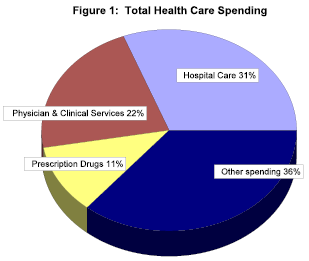
 Pie Chart of Total Health Care Spending

EXECUTIVE SUMMARY

Health care is a vital service that daily touches the lives of millions of Americans at significant and vulnerable times: birth, illness, and death. In recent decades, technology, pharmaceuticals, and know-how have substantially improved how care is delivered and the prospects for recovery. American markets for innovation in pharmaceuticals and medical devices are second to none. The miracles of modern medicine have become almost commonplace. At its best, American health care is the best in the world.
Notwithstanding these extraordinary achievements, the cost, quality, and accessibility of American health care have become major legislative and policy issues. Substantial increases in the cost of health care have placed considerable stress on federal, state, and household budgets, as well as the employment-based health insurance system. Health care quality varies widely, even after controlling for cost, source of payment, and patient preferences. Many Americans lack health insurance coverage at some point during any given year. The costs of providing uncompensated care are a substantial burden for many health care providers, other consumers, and tax payers.
This Report examines the role of competition in addressing these challenges. The proper role of competition in health care markets has long been debated. For much of our history, federal and state regulators, judges, and academic commentators saw health care as a "special" good to which normal economic forces did not apply. Skepticism about the role of competition in health care continues.
 https://www.justice.gov/atr/executive-summary